A recent paper argues that when you fine-tune one model on several conflicting tasks, supervised fine-tuning tears itself apart while reinforcement learning lets the tasks coexist. We built a small, controlled reproduction to see if that holds. The headline: it is not a universal law. It holds decisively under one specific condition, and it flips the other way without it.
What we did
We stripped the claim down to a mechanism check in pure PyTorch: a shared, deliberately undersized network trained on three conflicting tasks. Same architecture, same optimiser, same learning rate, same steps, same data across both regimes. The only thing that changes is the loss. SFT imitates an exact target with cross-entropy. RL samples an action, gives it a reward of one when it is acceptable, and reinforces it (REINFORCE with a per-task baseline). Five seeds each, about fifteen seconds a run, so anyone can rerun it.
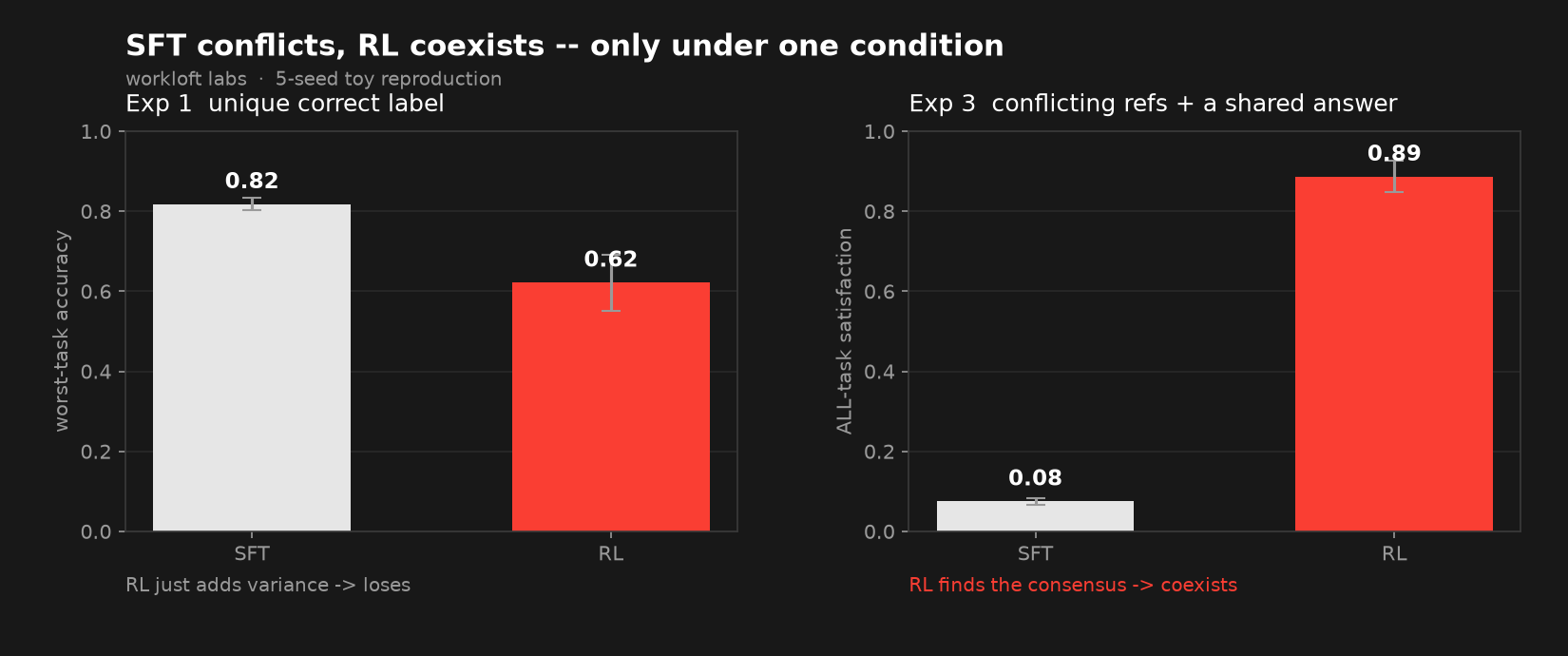
We ran three versions. First, each task has a single unique correct label. Second, each task accepts one of two answers but the model is told which task it is on. Third, one shared policy has to answer without being told the task, the per-task references genuinely disagree, and there is a single consensus answer that satisfies every task but is no task's own reference.
Why it was worth doing
The result is a clean boundary condition, not a slogan. In the first two setups the claim fails: SFT wins worst-task accuracy 0.82 to 0.62. RL's gradients did interfere less (average cosine minus 0.037 against minus 0.083), exactly as the theory says, but that lower conflict did not predict the winner. When the supervised target is already the one right answer, REINFORCE only adds variance and loses.
In the third setup the claim holds, and hard. RL finds the consensus answer 88.5 per cent of the time and satisfies all three tasks at once (0.89). SFT, mode-forced toward three conflicting references for the same input, hits the consensus 3.8 per cent of the time and collapses to 0.08. That is a plus 0.81 swing. The effect is real, but it needs two things together: several acceptable outputs, and genuine conflict between the single references SFT copies, with a compatible answer only an outcome-based reward can discover.
What's still off
This is a toy, not the paper's language-model result. It shows the mechanism, not the scale. Real post-training adds a pretrained initialisation, KL-regularised RL such as PPO or GRPO, and sequence-level rewards, none of which are here. But the practical lesson survives the shrink: if you are fine-tuning a multi-skill agent and your SFT targets are the unique gold answer, switching to RL will not fix task interference, it will just cost you variance. RL's coexistence advantage shows up specifically when your references disagree but outcomes can align. And gradient-conflict dashboards, on their own, tracked the wrong winner here, so do not trust them as a standalone proxy.